foam ompression machine
From Foam Block to Roll: A Complete Packing Guide
Foam blocks are commonly used in mattress, sofa, furniture, and cushioning production, but their large volume can make storage and transportation difficult. A well-designed compression roll-packing process can transform bulky foam blocks into compact cylindrical packages, making them easier to handle, store, and transport.
This guide explains how foam blocks are prepared, compressed, sealed, and rolled, as well as the key factors manufacturers should consider when selecting packaging equipment.
Step 1: Prepare the Foam Block
Before packaging, check the foam block's length, width, and height. The foam should be properly cut and free from materials that could interfere with compression or heat sealing.
Foam density and material characteristics are also important. Different types of foam can have different compression and recovery properties, so manufacturers should test their products before establishing final packaging parameters.
Step 2: Select the Correct Packaging Bag
The foam block is placed inside a PE or PVC bag before compression. The bag should be large enough to cover the product while avoiding excessive unused material.
A correctly sized bag helps the foam compress evenly and makes the subsequent sealing and rolling process more stable. If the bag is too small, it may restrict compression or become damaged. If it is excessively large, the final package may be unnecessarily bulky.
Step 3: Place the Bagged Foam on the Machine
After the foam block has been inserted into the packaging bag, the operator places the bagged product onto the machine's working area or roller table.
The product should be positioned correctly before compression begins. Proper positioning helps distribute hydraulic pressure more evenly and contributes to consistent package dimensions.
Step 4: Compress the Foam Block
The compression stage reduces the height and overall volume of the foam. A hydraulic press applies controlled pressure to flatten the product to the required compression position.
A suitable foam compression machine should provide sufficient pressure while allowing manufacturers to control the compression process according to the foam material.
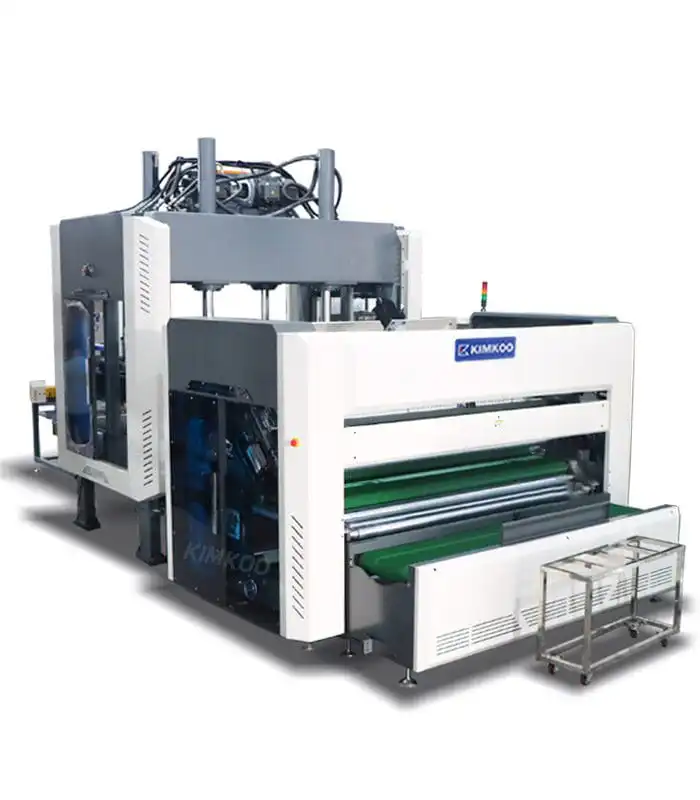
KIMKOO's JK-C3R provides up to 120 tons of hydraulic pressure and uses four hydraulic cylinders to provide stable compression across the working area. It supports products with heights from 50 to 1000 mm.
Step 5: Heat Seal the Compressed Foam
Foam naturally tends to expand after external pressure is removed. Heat sealing the packaging film helps retain the compressed condition and prevents rapid air entry into the package.
A strong seal also protects the foam from dust and moisture during storage and transportation. Sealing temperature and time should be adjusted according to the packaging film being used.
Step 6: Roll the Compressed Product
Once the foam has been compressed and sealed, it enters the roll-packing stage. The machine rolls the compressed product into a cylindrical package.
The final roll diameter can be adjusted according to product dimensions and transportation requirements. An intelligent roll-pack system can use PLC-controlled parameters to maintain consistent package sizes during repeated production.
This is particularly useful for manufacturers that need to process different foam block sizes on the same production line.
Step 7: Prepare the Roll for Shipping
The finished roll is significantly more compact than the original foam block. Depending on the product and shipping method, the rolled package can be handled directly or inserted into a carton.
Carton packaging can provide an additional layer of protection while creating a cleaner and more standardized appearance for transportation and delivery.
How Much Volume Can Foam Compression Reduce?
The achievable volume reduction depends on foam density, material composition, original dimensions, compression ratio, and packaging conditions. Under suitable conditions, compression roll-packing equipment can reduce the volume of certain foam products by up to 90%.
Manufacturers should not assume that every foam product can achieve the same reduction. Product testing is recommended to determine a practical compression ratio that balances transportation efficiency with product recovery.
What Foam Products Can Be Roll Packed?
Compression roll packing can be used for a variety of resilient products, including foam blocks, foam sheets, foam layers, foam sofas, mattresses, and other flexible products.
A foam block compression machine can be particularly useful for factories that need to reduce the shipping volume of large foam blocks before transportation.
Important Factors When Choosing a Machine
Manufacturers should consider several specifications before purchasing compression roll-packing equipment:
- Foam material and density
- Maximum product length, width, and height
- Required compression ratio
- Compression force
- Compression plate dimensions
- Target roll diameter
- Packaging film type
- Required production capacity
- Available factory power supply
For example, the JK-C3R has a 2100 × 2300 mm compression plate, supports product heights up to 1000 mm, and has a typical complete cycle of approximately 45–55 seconds per unit, depending on the product and operating conditions.
About KIMKOO Mattress Machinery
KIMKOO Mattress Machinery is an experienced mattress machine manufacturer with more than 18 years of experience in machinery design and manufacturing. The company develops equipment for mattress production, foam processing, sofa packaging, and compression roll-packing applications.
KIMKOO's JK-C3R combines hydraulic compression, heat sealing, and automatic roll packing into one system. Its touchscreen PLC control system with SIEMENS components allows operators to adjust key packaging parameters for different products and production requirements.
Common Foam Roll-Packing Mistakes
Several simple mistakes can reduce packaging efficiency. Using an incorrectly sized bag, applying an unsuitable compression ratio, selecting an inappropriate roll diameter, or failing to test foam recovery can all lead to inconsistent results.
Manufacturers should establish packaging parameters through product testing before starting large-scale production. Once the correct settings are confirmed, maintaining consistent product dimensions and machine parameters can improve both packaging quality and production efficiency.
Conclusion
The process from foam block to finished roll involves several connected stages: product preparation, bagging, hydraulic compression, heat sealing, and roll packing. Each stage affects the final package, so efficient foam packaging requires the entire process to be properly matched to the foam material and product dimensions.
With the right compression roll-packing system, manufacturers can significantly reduce product volume, improve warehouse utilization, simplify handling, and make transportation more efficient. Testing the actual foam products and selecting equipment according to real production requirements are the best ways to achieve consistent long-term results.
Related tags: foam ompression machine, foam block compression machine